
Modern home crochet is built on a simple foundation: functional textures, honest natural fibers, and clean geometric edges that elevate everyday living spaces. Whether you want to hook durable waffle dishcloths, square coffee coasters, or tactile plant basket covers, mastering a few core principles will transform your handiwork from loose swatches into heirloom-quality home textiles.
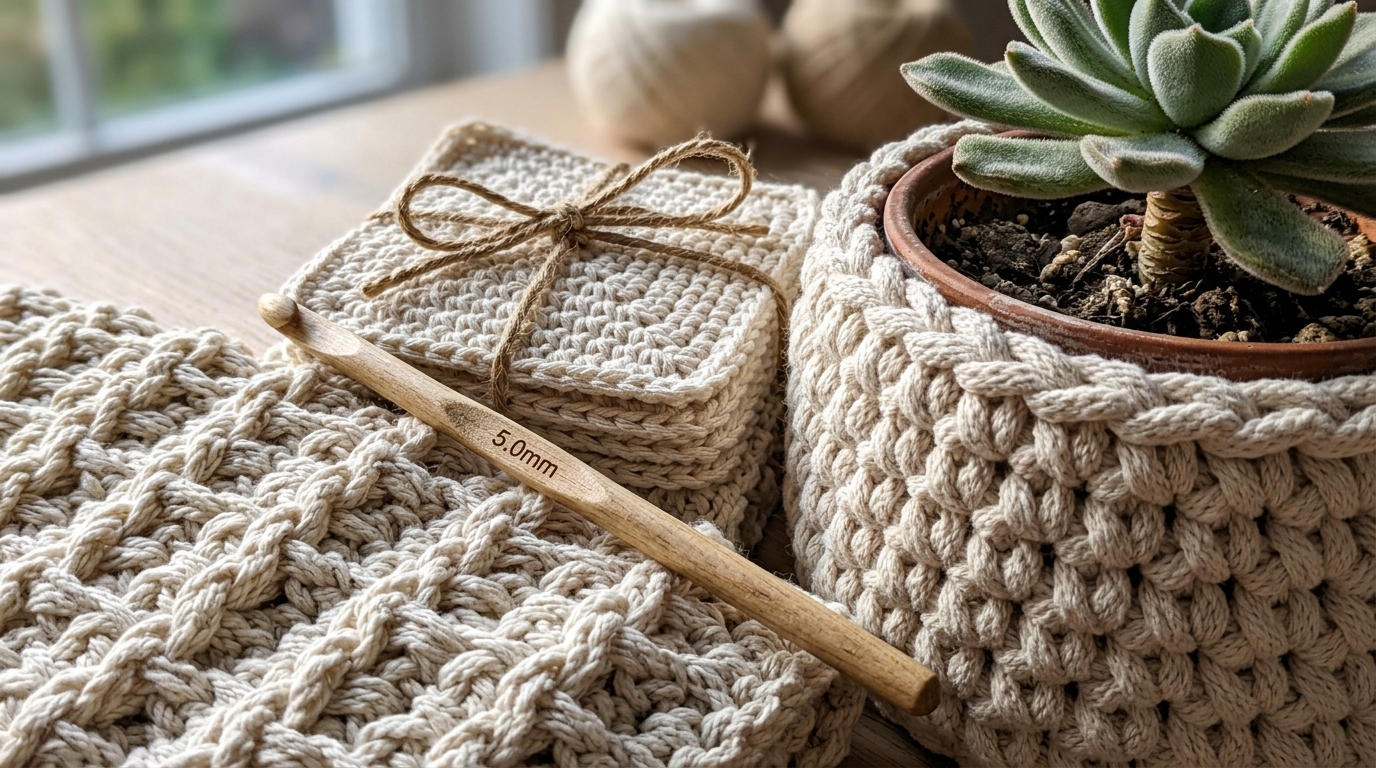
When I started hooking home goods in my studio over seven years ago, I fell into the same traps many beginner makers encounter: choosing slippery synthetic yarn that melted under hot cookware, working turning chains so tightly that edges curled inward like potato chips, and skipping gauge swatches altogether. Functional home decor demands a maker mindset centered on durability and honest fiber behavior. This roadmap covers the exact materials, tools, and technical cues you need to create crisp, functional pieces with complete confidence.
Maker’s Project Roadmap Blueprint
- Skill Level: Confident Beginner / Maker Foundation
- Core Fibers: 100% Unmercerized Worsted (#4) Kitchen Cotton & Natural Linen-Cotton Blends
- Recommended Hooks: US G/6 (4.0 mm) to US H/8 (5.0 mm) Ergonomic In-Line Hooks
- Stitch Arsenal: Foundation Single Crochet, Half Double Slip Stitch, Herringbone HDC, Crab Stitch
- Key Studio Rule: Measure unblocked gauge first; wet-block with stainless pins for permanent square corners.
- Testing & Design: Tested & documented by Julian Brooks in natural kitchen cotton.
1. The Essential Fiber & Tool Arsenal

Every long-lasting home crochet project begins with honest material selection. For items that see active kitchen or living room duty, your choice of yarn dictates absorbency, heat tolerance, and structural integrity:
- 100% Unmercerized Kitchen Cotton: The absolute gold standard for dishcloths, trivets, and placemats. Unmercerized cotton absorbs water rapidly, withstands boiling wash cycles, and will never scorch under warm dishes.
- Ergonomic Aluminum or Wooden Hooks: Long stitching sessions demand tools that protect your hands. Hooks with molded elastomer handles (such as Clover Amour or Tulip Etimo) reduce wrist fatigue and ensure uniform loop heights.
- Blunt Bent-Tip Tapestry Needle: Essential for weaving yarn tails securely through textured stitches without splitting the fiber plies.
- Fiberglass Measuring Tape: Never trust stitch counts alone. Checking your dimensions in inches and millimeters every four rows prevents accidental tapering.
2. Foundational Stitches Every Home Maker Needs
You don’t need dozens of complex stitch patterns to produce striking home textiles. In fact, four reliable stitches form the backbone of modern minimalist design:
- Foundation Single Crochet (FSC): Eliminates the tight, restrictive starting chain. Working the chain and first row simultaneously creates an elastic edge that never flares or bows.
- Half Double Crochet (HDC): The workhorse of cozy home textiles. Its third loop offers unique opportunities to create ribbed, knit-like horizontal textures.
- Moss Stitch (Sc 1, Ch 1 Repeat): Creates a dense, reversible fabric with virtually zero hole visibility — ideal for hot pads and pot holders.
- Crab Stitch (Reverse Single Crochet): Worked from left to right instead of right to left, this creates a sturdy corded border that locks coaster edges flat permanently.
3. Step-by-Step Execution: Building Clean Tension

The hallmark of professional handmade work is uniform stitch tension from row 1 to completion. When working square home textiles:
1. Maintain the “Golden Loop”: When drawing up your working yarn, lift the loop to the height of the current row before wrapping the hook. Pulling down too tightly compresses the stitch, causing edges to curl inward.
2. Count Turning Stitches Accurately: Missing the final turning chain or accidentally working into the slip knot is the number one cause of shrinking widths. Place a locking stitch marker in the first and last stitch of every row until your eye recognizes the edge structure naturally.
3. Work Clean 3-Stitch Corners: Whenever adding an edge border to a square piece, always place exactly 3 single crochets into the apex of each corner. This provides the exact radial fullness needed to turn a 90-degree angle without cup distortion.
4. Three Studio Testing Rules for Flat, Crisp Results
1. Loosen Foundation Chains by Half a Hook Size: If you use a traditional chain start instead of FSC, work your foundation with a hook 0.5 mm larger than your main project. This compensates for chain tension and guarantees straight bottom edges.
2. The 10ml Water Test for Kitchen Linens: Before hooking an entire matching dishcloth set, test a 4×4-inch swatch with a water dropper. Pure unmercerized cotton absorbs 10ml of water in under 4 seconds, whereas acrylic fiber repels water and pools on the surface.
3. Wet Blocking Is Mandatory: Never skip blocking! Submerge finished cotton pieces in lukewarm water for 15 minutes, gently squeeze in a dry towel, and pin out to exact dimensions on dense foam boards. Once dry, the cotton fibers “remember” the square shape through dozens of wash cycles.
5. Styling Handmade Crochet in Modern Living Spaces

Handmade fiber decor looks best when integrated into organic modern vignettes. Fold textured cream dishcloths in a shallow stoneware tray next to olive oil cruets, stack square coasters under matte ceramic mugs on oak coffee tables, or roll washcloths in open woven baskets in the guest bath. High-contrast neutral tones—such as oatmeal, sand, charcoal, and eucalyptus—highlight intricate stitch textures while complementing natural woods and stone surfaces.
Care & Laundering Guide for Kitchen Cotton
- Machine Washing: Wash in cold or warm water with like colors. Avoid chlorine bleach which breaks down natural cellulose fibers over time.
- Drying: Tumble dry on medium heat or reshape and lay flat on a drying rack. Kitchen cotton naturally thickens and softens with every wash cycle.
- Reshaping: If corners curl slightly after aggressive spin cycles, a quick steam iron on the cotton setting restores crisp 90-degree angles in seconds.
Frequently Asked Questions
Can I use acrylic yarn for home kitchen crochet?
No. Acrylic is made of extruded plastic fibers that do not absorb moisture and will melt or scorch if exposed to hot pots or boiling kettles. Always choose 100% natural cotton or linen blends for kitchen items.
Why are the edges of my square project waving or ruffling?
Wavy or ruffled edges indicate too many stitches. Ensure you are not accidentally increasing at row ends, and limit corner border increases to strictly 3 stitches per corner.
How do I fix tension differences between rows?
Tension shifts typically happen when you change gripping positions or stitch during fatigue. Practice resting your forearm on a flat surface and use an ergonomic hook to standardize loop height across every row.