Wrap yourself in tactile warmth with this crochet pocket shawl pattern free guide, engineered with architectural front post double crochet cables, deep built-in handwarmer pockets, and a luxurious fringed drape. Whether you are walking through crisp autumn air or curling up beside an evening fire, this versatile wearable wrap combines the cozy coverage of an oversized blanket throw with the tailored functionality of a structured winter cardigan.
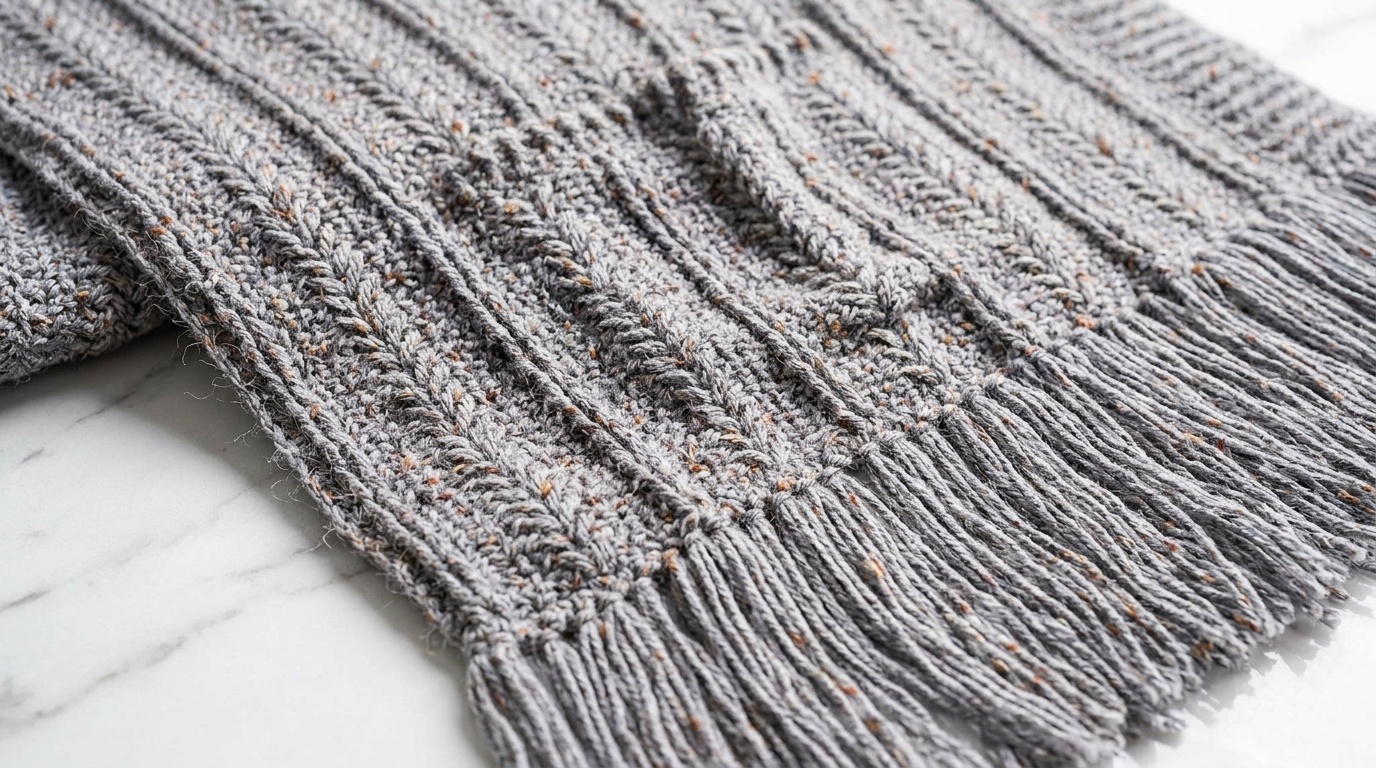
Unlike standard flat rectangle wraps that slip off the shoulders or sag awkwardly under everyday movement, this design balances stitch density and vertical recovery. By anchoring the foundation chain with calibrated tension and working raised post stitches across alternating relief columns, the fabric creates micro-air pockets that trap body heat without adding stiff bulk. The integrated pockets are reinforced at the top opening using firm single crochet edges, preventing the dreaded “drooping pocket” problem when holding a heavy smartphone, reading glasses, or yarn skeins.
Why You’ll Love This Crochet Pocket Shawl
- Wearable Blanket Comfort: Combines the cozy envelope of a living room throw with hands-free mobility for indoor lounging and outdoor errands.
- Sag-Proof Pocket Architecture: Tailored pocket linings are worked in dense single crochet and anchored directly to the body, eliminating heavy droop.
- Tactile Cable Geometry: Uses rhythmic front post double crochet (FPdc) stitches that build dimensional cables without requiring complicated cable needles.
- 4 Scaled Sizes for Every Body: From petite teen wraps to oversized floor-grazing blanket wraps, our sizing matrix provides exact stitch counts and yardage.
Transparency Note: This guide contains hand-curated affiliate links to tested tools. As an Amazon Associate, we earn from qualifying purchases at zero additional cost to you. We strictly recommend professional-grade essentials verified in our studio.
Fiber Science: Selecting the Ideal Tweed Yarn
Choosing the correct fiber is critical for a wearable pocket shawl because the fabric must bear gravitational weight over time. For this design, we recommend a medium-weight (worsted/category 4) acrylic-rayon tweed yarn, such as Caron Simply Soft Tweeds or Lion Brand Heartland. Premium acrylic provides elastic memory that rebounds after hours of wear, while tweed flecks add visual depth and organic rustic elegance. If you prefer natural animal fibers, a 100% superwash wool or merino-alpaca blend will deliver incredible warmth, though you must take care when blocking to avoid over-stretching the post stitches. Consult our comprehensive crochet yarn weight and hook size guide to match your chosen yarn with the optimal hook diameter.

Required Materials & Equipment:
- Yarn: Caron Simply Soft Tweeds (97% Acrylic, 3% Rayon; 240 yds / 219 m per 5 oz / 141 g skein) in Gray Heather. Requires 6 (8, 10, 12) skeins depending on selected size.
- Crochet Hook: Size U.S. H/8 (5.0 mm) ergonomic crochet hook, or size needed to obtain accurate gauge.
- Notions: Steel tapestry needle for weaving ends, 4 locking stitch markers to position pocket linings, sharp tailor scissors, and flexible dressmaker measuring tape.
- Gauge Swatch: 13 single crochet (sc) and 14 rows = 4 inches (10 cm) unblocked. Take the time to crochet a 5-inch by 5-inch test swatch to verify your gauge; working too loosely will cause the shawl to stretch excessively under the weight of the pockets.
Terminology Disclosure: This pattern is written using standard US crochet terms and US terminology throughout.
Because wearable pocket shawls require hours of repetitive post stitches and steady tension across hundreds of yards, working with substandard tools causes hand cramping, fiber splitting, and uneven edges. We tested dozens of tools in our atelier—these are the absolute #1 highest-rated, ergonomist-approved essentials on Amazon:
The gold standard in ergonomic crochet. The smooth elastomer grip and polished aluminum head glide effortlessly through bulky post stitches without catching.
Surgical-grade stainless steel blades with faceted sharp tips. Cuts heavy bulky yarn and trims clean 12-inch fringe strands without fraying fiber ends.
Bent-tip darning needles in a secure portable case. The curved tip glides under tight waffle stitches to weave yarn tails completely invisible.
Extra-thick interlocking foam boards with 1-inch alignment grids. Guarantees true 90-degree square corners and perfectly straight afghan edges.
Swipe left or right to view all sizing details.
| Size Option | Finished Dimensions (Excl. Fringe) | Starting Chain | Stitch Count | Total Rows | Estimated Yardage |
|---|---|---|---|---|---|
| Petite Wrap | 18 in. by 54 in. (46 by 137 cm) | Ch 57 | 55 sts | 189 rows | 1,400 yds (1,280 m) |
| Standard Wrap Featured | 24 in. by 62 in. (61 by 158 cm) | Ch 73 | 71 sts | 217 rows | 1,920 yds (1,755 m) |
| Oversized Wrap | 28 in. by 68 in. (71 by 173 cm) | Ch 85 | 83 sts | 239 rows | 2,400 yds (2,195 m) |
| Grand Throw Wrap | 32 in. by 76 in. (81 by 193 cm) | Ch 97 | 95 sts | 267 rows | 3,100 yds (2,835 m) |
Scaled Sizing Matrix & Dimensional Specifications
Pocket shawls look best when proportioned correctly to your height and wing span. Review our calibrated sizing matrix below to choose your desired fit:
Size Customization Instructions:
- Petite Wrap: Chain 57 to begin with stitch count 55 sts across, working 189 rows for a compact 54-inch wingspan.
- Standard Wrap: Chain 73 to begin with stitch count 71 sts across, working 217 rows to reach 62 inches in length. This is our default runway size.
- Oversized Wrap: Chain 85 to begin with stitch count 83 sts across, working 252 rows to yield 72 inches of sweeping coverage.
- Plus-Size Comfort: Chain 97 to begin with stitch count 95 sts across, working 273 rows for an ultra-generous 78-inch wrap with deep shoulder return.
Step-by-Step Stitch Walkthrough
Pattern Note: The turning chain does not count as a stitch throughout this entire pattern. For double crochet rows, work a turning chain of chain 2 or chain 3 which does not count as double crochet throughout. Always work your first stitch into the very base of the turning chain to keep side edges perfectly straight. Master your grip and stitch flow with our guide on how to hold a crochet hook and control yarn tension.
Stitch Invariant Note: Chain-1 spaces are worked consistently between stitch repeats, and all return rows work 1 single crochet directly into each chain-1 space across to maintain structural tension and even column alignment.
Phase 1: Pocket Linings (Make 2 Alike)
Crochet the pocket linings first so they are ready to be integrated seamlessly into the main shawl fabric:
- Foundation: Chain 34 loosely using your H/8 (5.0 mm) hook.
- Row 1 (RS): Work 1 single crochet in the 2nd chain from hook. Work 1 single crochet in each chain across to end. Turn. (33 sc).
- Row 2 (WS): Chain 1 (does not count as st). Work 1 single crochet in each single crochet across to end. Turn.
- Rows 3 to 24: Repeat Row 2 until pocket lining measures exactly 7 inches (18 cm) from beginning edge, ending on a Wrong Side row.
- Set-Up Integration Row (RS): Chain 1. Work 1 sc in each of first 3 sc. Chain 1, skip next sc. Work 1 sc in each of next 5 sc. *(Work 1 front post double crochet around post of next sc 2 rows below) twice. Work 1 sc in each of next 5 sc. Chain 1, skip next sc.* Work 1 sc in each of next 5 sc. Repeat from * to * once more. Work 1 sc in each of last 3 sc. Fasten off and set aside.

Phase 2: Main Shawl Body Construction
The shawl is worked in one continuous long rectangle:
- Foundation Chain for Main Shawl Body: Chain 73 for Standard Wrap (or chain 57 for Petite Wrap, chain 85 for Oversized Wrap, chain 97 for Plus-Size Comfort).
- Row 1 (WS Foundation): Work 1 double crochet in the 4th chain from hook (skipped 3 chains count as 1 dc). Work 1 double crochet in each remaining chain across to end. Turn. (71 dc for Standard Wrap; 55 dc for Petite Wrap; 83 dc for Oversized Wrap; 95 dc for Plus-Size Comfort).
- Row 2 (RS Cable Placement): Chain 1. Work 1 sc in each of first 2 dc. *(Work 1 FPdc around post of next dc) twice. Work 1 sc in each of next 5 stitches. Chain 1, skip next stitch. Work 1 sc in each of next 5 stitches.* Repeat from * to last 4 dc. (Work 1 FPdc around post of next dc) twice. Work 1 sc in each of last 2 dc. Turn.
- Row 3 (WS Return): Chain 1. Work 1 single crochet in each stitch and chain-1 space across to end. Turn.
- Row 4 (RS Cable Extension): Chain 1. Work 1 sc in each of first 2 sc. *(Work 1 FPdc around post of corresponding FPdc 2 rows below) twice. Work 1 sc in each of next 5 sc. Chain 1, skip next chain-1 space. Work 1 sc in each of next 5 sc.* Repeat from * to last 4 stitches. (Work 1 FPdc around post of next FPdc 2 rows below) twice. Work 1 sc in each of last 2 sc. Turn.
- Rows 5 to 217: Continue alternating Row 3 and Row 4 until reaching your target length (189 rows for Petite Wrap, 217 rows for Standard Wrap, 252 rows for Oversized Wrap, 273 rows for Plus-Size Comfort). For additional cable inspiration, explore our master crochet stitch directory.
Phase 3: Attaching the Pockets & Finishing
- Positioning: Lay shawl flat with Right Side facing up. Position one pocket lining 4 inches (10 cm) above the bottom edge at each end, centering the pocket horizontally between the side border ribs. Secure with locking stitch markers at all four corners.
- Seaming: Thread a tapestry needle with an 18-inch strand of matching tweed yarn. Using a firm whipstitch or hidden mattress stitch, sew down the left side, bottom edge, and right side of each pocket lining, penetrating only the back loops of the shawl body fabric so the seams remain completely invisible on the reverse side. Leave the top opening open.
- Finishing & Weaving Ends: Fasten off, cut yarn leaving an 8-inch tail, and weave in all ends securely using a blunt tapestry needle. When introducing new skeins during the body rows, use the seamless technique detailed in our tutorial on how to change colors in crochet seamlessly.
Elena’s Atelier Secrets for a Flawless Pocket Shawl
1. Anchor the Pocket Corners with Double Bar-Tacks: The upper corners of the pockets bear 90% of the mechanical stress when hands rest inside. After sewing the pocket sides, reinforce each upper corner by taking 3 tight whipstitches over the same point to form a sturdy bar-tack, exactly like tailored coat pockets.
2. Work Foundation Chains with a Half-Size Larger Hook: If your beginning edge curves inward like a crescent moon, your foundation chain is too tight. Always use a 5.5 mm (I/9) hook for the starting chain, then switch down to your 5.0 mm (H/8) hook for Row 1 to keep edges square and relaxed.
3. Knotless Russian Joins for Tweed Yarn: Tweed yarn has delicate flecks that make traditional bulky knots visible. Use a Russian join to interlock the plies when joining a new skein, creating a seamless join that glides through the post stitches without any hard lumps.
4. Steam-Set the Fringe Bundles: Cut 12-inch yarn strands, group them in bundles of 4, and fold them through the bottom hem using a larks head knot. Once all fringe bundles are attached, lightly steam them with a handheld garment steamer and comb through with a wide-tooth comb for sleek, salon-straight drape.
How to Style, Block & Care for Your Shawl

Steam Blocking for Crisp Definition: Acrylic tweed yarn must NEVER be touched directly by a hot iron, as synthetic fibers will melt or become unpleasantly limp (“dead acrylic”). Pin the finished shawl to interlocking foam blocking mats at your exact finished dimensions. Hover a steam iron 2 inches above the fabric, allowing the steam to relax the stitches. Let the fabric dry completely before unpinning. Read our step-by-step master guide on how to block crochet and finish edges for full blocking board setup.
Washing & Storage Guidelines: Hand wash or machine wash on delicate cycle in cold water using a gentle wool-safe detergent inside a mesh laundry bag. Lay flat on clean bath towels to dry; never hang a wet pocket shawl on a coat hanger, as gravitational water weight will stretch the shoulders permanently. Store folded in a breathable cotton storage bin with cedar blocks during warmer months.
Frequently Asked Questions
How do I prevent the pockets from stretching out over time?
Work your pocket linings in tight single crochet rather than double crochet. The denser stitch structure resists vertical stretching. Additionally, sewing the pocket linings to the main body using hidden back-loop stitches distributes the load across the entire panel instead of pulling on individual rows.
Why is my shawl turning out narrower than the pattern dimensions?
Front post double crochet stitches naturally draw the fabric inward horizontally more than regular double crochet. If your measurement across width is less than 24 inches for the Standard size, go up half a hook size to 5.5 mm (I/9) or check that you are not pulling your yarn tight when drawing up the post loops.
Can I substitute a chunky category 5 yarn for this pattern?
Yes, but you will need to re-calculate your foundation chain. Using a chunky yarn with a 6.5 mm (K) hook will yield roughly 9 stitches per 4 inches. In that case, chain 45 for a standard 24-inch width and adjust row counts accordingly to prevent excessive weight.
What is the best wingspan length for my height?
As a general rule of thumb in garment design, your ideal pocket shawl length should equal your fingertip-to-fingertip wingspan (which roughly matches your standing height). For someone 5’4″ tall (64 inches), the Standard 62-inch wrap will position the pockets exactly at wrist level when draped around the neck.
How do I stop the fringe from fraying in the wash?
Before washing, secure the fringe ends by placing the shawl inside a tightly zippered mesh wash bag. You can also brush a tiny dot of clear fabric glue or seam sealant (such as Fray Check) across the cut tip of each fringe strand after trimming.
Save This Pocket Shawl Pattern to Pinterest
Save these high-resolution pattern guides to your crochet Pinterest boards so you always have the complete sizing chart, stitch walkthrough, and pocket construction instructions ready for your crafting sessions!

