


Transitioning to a zero-waste bathroom routine begins with the simplest everyday habits. Single-use disposable cotton rounds produce unnecessary bathroom waste and often break down or leave lint during toner application. In contrast, these reusable crochet face scrubbies utilize plump, pillowy puff stitches worked in pure unmercerized cotton to create a luxurious exfoliating disc that cleanses gently, washes effortlessly in the laundry, and lasts for years.
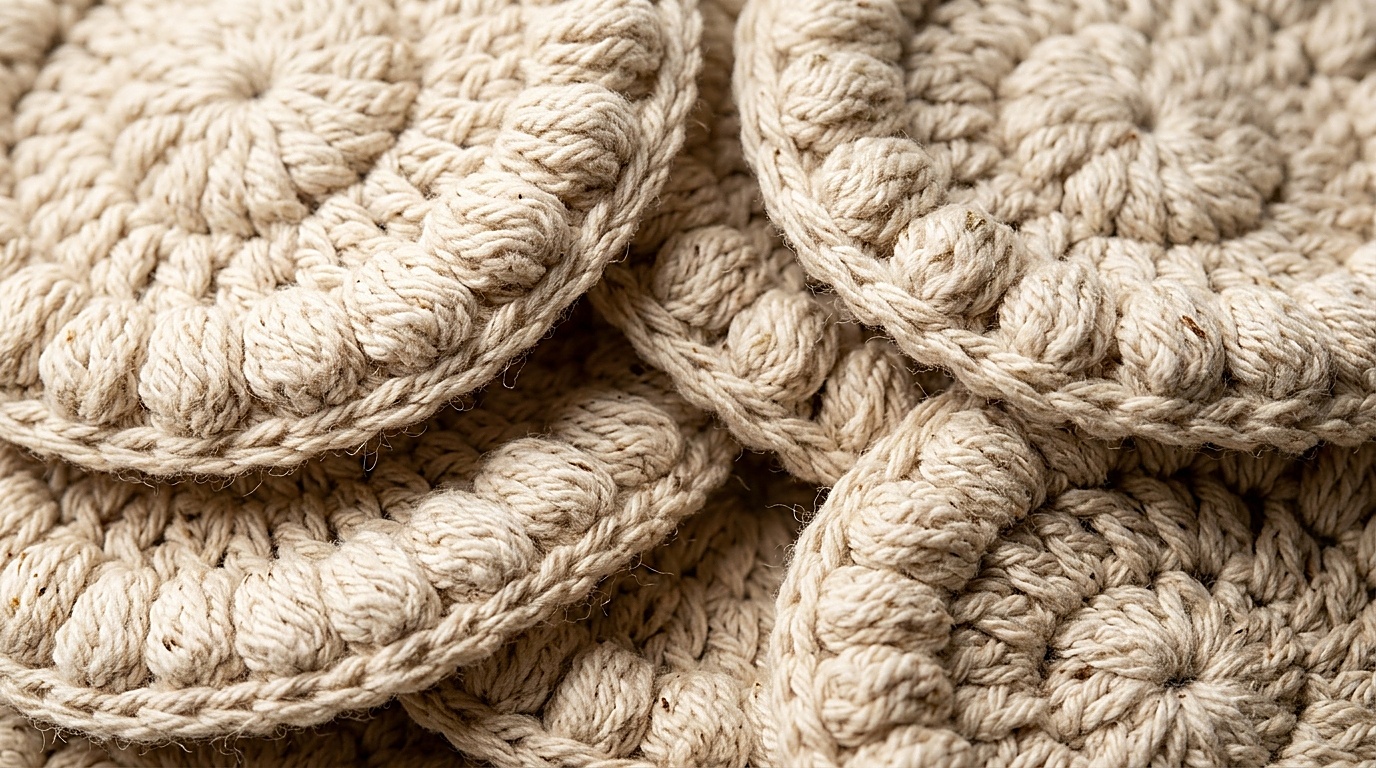
Unlike flat single-crochet discs that quickly become limp when soaked with water, the structural volume of clustered puff stitches acts like an absorbent micro-sponge. Each round face pad holds just the right amount of facial cleanser or cleansing oil while providing gentle tactile stimulation to lift dull skin cells without irritation. Best of all, a single 50-gram skein of cotton yields an entire set of 6 to 8 scrubbies, making this one of the most rewarding quick weekend projects in our studio.
The Science of Sustainable Skincare: Why 100% Unmercerized Cotton Wins
When crafting items intended for daily facial contact and hot-water laundering, fiber selection is paramount to skin health and project longevity:
- Unmercerized Cotton Absorbency: Standard mercerized cotton undergoes chemical baths that seal the fiber cuticle for sheen, which repels water initially. Unmercerized (matte) craft cotton—such as Lily Sugar ‘n Cream, Paintbox Yarns Cotton Aran, or WeCrochet Dishie—maintains open botanical pores that instantly absorb cleansers and micellar water.
- Zero Plastic Microfiber Shedding: Synthetic yarns (acrylic, polyester, chenille) shed non-biodegradable microplastics down bathroom drains during washing. Pure cotton is 100% biodegradable and hypoallergenic for sensitive skin.
- Thermal Stability: Face pads require periodic high-temperature laundering to eliminate facial oils and makeup residue. Cotton fibers comfortably withstand 60°C (140°F) machine washing without shrinking or melting. For comprehensive kitchen and bath care insights, review our easy crochet dishcloth pattern guide.
Pattern Note: All instructions and stitch abbreviations throughout this guide are written using standard US crochet terminology (US terms). Across all sections, the turning chain does not count as a stitch throughout.
Texture Mechanics: The Exfoliating Puff Stitch Explained
The secret to this pad’s plush feel is the specialized puff stitch (abbreviated as puff st). Rather than completing individual stitches one by one, we draw up multiple prolonged yarn-over loops through the same base stitch before locking them together with a single chain:
How to Work the 4-Loop Puff Stitch: Yarn over, insert hook into designated stitch, yarn over and pull up a loop to the height of a half double crochet (3 loops on hook). [Yarn over, insert hook into same stitch, yarn over and pull up a loop] 3 more times (9 loops on hook). Yarn over and carefully draw through all 9 loops on your hook. Chain 1 to lock the puff stitch securely. This locking chain is an integral part of the puff and creates the stitch eye for the subsequent round.
For more foundational stitch variations, explore our master crochet stitch directory.
Studio Supplies & Recommended Specifications

Swipe left or right to see all columns.
| Item / Tool | Recommended Spec | Crafting Function |
|---|---|---|
| Yarn Type | 100% worsted weight #4 unmercerized cotton | High absorbency, soft texture, machine washable |
| Crochet Hook | 4.00 mm (US Size G/6) ergonomic aluminum | Maintains tight tension so puffs stay dense; see our yarn weight & hook guide |
| Yardage per Pad | Approximately 14–16 yards (13–15 meters) | A 50g skein makes 6–7 complete pads |
| Finished Diameter | 7.5 cm (3.0 inches) across | Comfortable palm fit for face washing |
| Notions | Tapestry needle, sharp snips, mesh wash pouch | Invisible join weaving and gentle laundering |
Step-by-Step Circular Construction Walkthrough
Each face pad is worked in the round starting from a magic ring and expanding radially over three concentric rounds:
Round 1 (Foundation Center): Make a magic ring (adjustable loop). Chain 1 (does not count as a stitch). Work 8 single crochet (sc) stitches into the magic ring. Pull the yarn tail firmly to close the center hole completely. Join with a slip stitch (sl st) to the first sc. (Stitch Count: 8 sc).

Round 2 (Puff Stitch Expansion): Chain 2 (does not count as a stitch throughout). Work 1 puff stitch into the first stitch, and chain 1 to lock the puff (this chain-1 is an integral part of the puff stitch structure and forms the working chain space for the next round). Work a second puff stitch into the very same stitch, chain 1 to lock. Repeat [work 2 puff stitches into the next stitch, chaining 1 after each puff to lock it] 7 more times around the circle. Join with a slip stitch (sl st) into the top eye of the very first puff stitch. (Stitch Count: 16 puff stitches & 16 ch-1 spaces).
Round 3 (Outer Shell Border): Chain 1 (the turning chain does not count as a stitch throughout). Work 1 sc into the first ch-1 space between puffs, then work 2 sc into the next space. Repeat [1 sc in next space, 2 sc in next space] around the entire perimeter. This gradual increase stabilizes the ruffled edge and prevents the circle from cupping or waving. Join with a slip stitch to the first single crochet. (Stitch Count: 24 sc).
Elena’s Atelier Secret: The Seamless Invisible Finish Without a Bump
Because circular face pads have no front or back when cleansing, a standard slip stitch knot creates an unsightly knot on the outer perimeter. Here is how we execute the seamless needle join:
- After working the final single crochet of Round 3, cut your working yarn leaving an 8-inch (20 cm) tail.
- Pull the active loop straight up and completely out of the stitch without working a final slip stitch.
- Thread the yarn tail onto a blunt tapestry needle. Skip the first single crochet of Round 3, and insert your needle from back to front under both top loops of the second stitch.
- Pull the needle through, then insert it straight down into the center of the very last single crochet you made, right between the “V” loops.
- Gently tighten until this faux stitch matches the size and tension of the surrounding stitches. The join is completely indistinguishable, leaving a flawless circular perimeter that never scratches delicate eye skin.
- Fastening Off & Securing Ends: Turn the scrubby over, weave the remaining yarn tail securely back and forth through the dense base loops of the puff stitches on the wrong side, fasten off with a discreet locking knot around a hidden post, and trim excess yarn flush. Your face scrubby is now fully fastened off and ready for use.
Eco-Friendly Spa Gift Bundles & Bathroom Styling

Handmade scrubbies make beloved mindful gifts and spa basket additions. Combine 4 to 6 pads in coordinated neutral shades (ecru, oatmeal, sage green, and soft terracotta), stack them neatly, and tie the set with natural jute twine or herringbone linen ribbon. Pair the bundle with an artisan bar of cold-process lavender soap or botanical facial oil for a heartfelt, earth-friendly present. For more quick stash-busting ideas, see our roundup of the best easy crochet projects for beginners.
Sanitizing, Washing & Long-Term Cotton Care Protocol
Maintaining hygienic face scrubbies is straightforward with proper laundering habits:
- Daily Rinse: After each skincare use, rinse the pad under warm running water with a touch of mild soap to flush away foundation and oils. Squeeze out excess water and hang or rest flat on a slatted soap tray to dry completely.
- Weekly Machine Washing: Collect used pads inside a zippered mesh delicates bag. Wash with your regular towels at 40°C to 60°C (104°F to 140°F) using gentle detergent. The mesh bag prevents tiny pads from disappearing inside the washing machine filter.
- Drying & Reshaping: Tumble dry on low heat inside the bag or lay flat to air dry. If needed, pat the circles flat with your hands while damp to restore their crisp round geometry. For blocking and edge finishing details, consult our tutorial on blocking and edge-finishing techniques.
Maker Troubleshooting: Cupping, Waving & Loop Tension
Why is my circle curling into a bowl (cupping)?
Cupping occurs when your stitch gauge is too tight or your puff loops are pulled too short. Ensure that when you yarn over and pull up loops for each puff, you draw them up to a generous 1.5 cm height so the stitches have sufficient circumference to lie flat.
Why is my outer edge rippling like a potato chip (waving)?
Waving means you have too many stitches or your tension is too loose in Round 3. Drop down a half hook size to 3.5mm for the final round, or eliminate one increase repeat so the border hugs the inner puff ring securely.
Save This Face Scrubbies Pattern to Pinterest
Pin these high-resolution reference guides to your favorite Pinterest crochet boards so you always have the stitch counts, invisible finish steps, and eco-friendly gift bundling tips ready for your next quick make!

